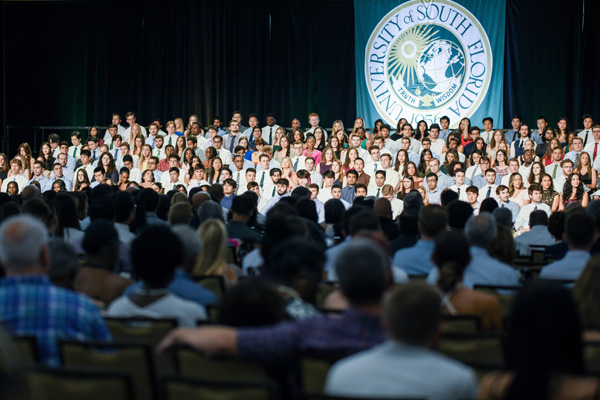
White coats a symbol of compassion, commitment
Focusing on patients as people as well as the data of their lab tests and medical histories is the foundation of true patient care. This advice, shared with […]
Class of 2027 White Coat Ceremony postponed
From Dr. Kira Zwygart, associate dean of the USF Health Morsani College of Medicine Office of Student Affairs regarding the Class of 2027 White Coat Ceremony: Dear class […]
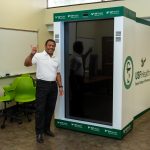
Taneja College of Pharmacy is using hologram technology to transform learning
The USF Health Taneja College of Pharmacy (TCOP) continues to be a pacesetter for innovative education, most recently with its plans to incorporate holographic technology into its […]
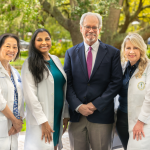
USF Health $5.6 million study to define link between genetics and heart disease in many Friedreich’s ataxia patients
Researchers at the USF Health Morsani College of Medicine were awarded $5.6 million of expected funds for a 4-year study from the U.S. Department of Defense to examine […]
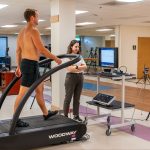
Irene Davis is revolutionizing runner’s injury rehab with gait retraining
Irene Davis, PhD, PT, FACSM, FAPTA, FASB, professor in the USF Health School of Physical Therapy and Rehabilitation Sciences, is trying to understand the intricate relationship […]
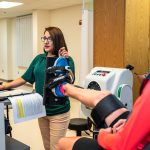
USF Health physical therapy program expands research footprint to improve patient outcomes
The USF Health School of Physical Therapy and Rehabilitation Sciences (SPTRS) is taking strides to expand its research efforts and contribute significantly to the improvement of patient care […]

Dr. Racha Khalaf advances EoE monitoring at USF Health with new string test
The Esophageal String Test is a brand-new option, and USF Health is one of only three sites in the country offering it. Racha Khalaf, MD, assistant professor and […]

U.S. News rankings place Tampa General and specialties led or co-led by USF Health faculty among the nation’s best
Tampa General Hospital continues to be the best hospital in the Tampa Bay area, as today’s release of the 2023-24 rankings by U.S. News & World Report show. […]
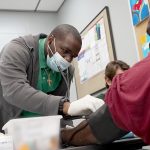
USF Health Leads the Charge to Strengthen Community Health by Focusing on Family Medicine
Family medicine, considered the oldest and broadest subspecialty of medicine, plays a critical role in maintaining community health and access to care. In fact, 90 percent of primary […]

USF Health Morsani College of Medicine welcomes newest medical students
Excitement, anticipation, a few tears of joy were all part of the experience at the USF Health Morsani College of Medicine and Heart Institute today as the medical […]

Hearing aids slow cognitive decline in older adults with hearing loss and at risk for cognitive decline
Using a comprehensive hearing intervention designed, tested, and implemented by researchers at the University of South Florida, the multi-site ACHIEVE study examined the efficacy of hearing aids for […]
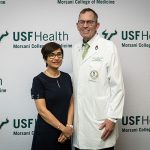
Internal Medicine chair steps down, joins International Medicine Program
John Sinnott, MD, will step down July 1 from his role as chair of the Department of Internal Medicine in the USF Health Morsani College of Medicine. Dr. […]
USF Health offers combined ENT/Allergy clinic to better address chronic sinusitis
The complexities and nuances for successfully treating chronic sinusitis usually involves two medical specialists, an otolaryngologist-head and neck surgeon (also called an ENT) and an allergist/immunologist. Patients with […]
TCOP and Florida Education Fund partner for STEM opportunity
The USF Health Taneja College of Pharmacy (TCOP) partnered with the Florida Education Fund […]
USF professors focus diverse skills into life-saving stroke device
Who said engineering and neuroscience aren’t good bedfellows? Two University of South Florida professors are proof that disparate disciplines can work together for a common cause – gaining […]

USF Health Physical Therapy Center re-opens in new location
Moving an entire clinic can be a very daunting and cumbersome task, especially when you have to get it ready for patients only a few days later. The […]
Blog

Search USF Health News
Can’t find a news post?
USF Health Communications
Media relations, internal/marketing communications, social media, community outreach and more.